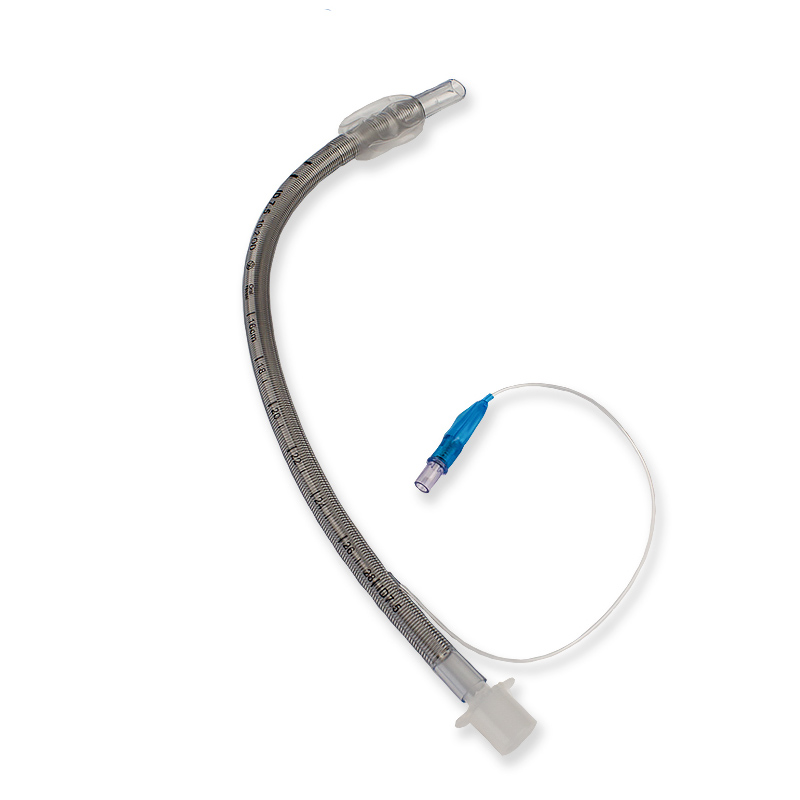
Reinforced Cuffed Endotracheal Tube (ETT)

Designed to address the unique challenges of difficult airways and prolonged respiratory support—where tube flexibility, kink-resistance, and reliability are non-negotiable—our Reinforced Cuffed Endotracheal Tube (ETT) delivers consistent performance for high-acuity clinical settings, aligning with today’s focus on reducing airway-related complications.

Specifications

Size Range

3.0mm–10.0mm ID (supports pediatric, adult, and anatomically narrow airway populations)

Packaging

Sterile blister packs; 10 pcs/inner box, 100 pcs/outer carton

Carton Dimensions

49×37.5×34 (optimized for standard storage and bulk procurement)

Sterility

Latex- and DEHP-free; ISO-compliant biocompatible construction; Ethylene Oxide (EO)-sterilized (ready for immediate clinical use)

Integrated metal coil along the tube shaft (reinforced-model exclusive)

Dedicated shaping stylet for customized tube manipulation

Seals the airway for mechanical ventilation compatibility

Latex- and DEHP-free construction

Contamination-resistant, ready-to-use design

The wire coil boosts shaft flexibility while eliminating kinking (reduces airway obstruction risk by 40% vs. non-reinforced ETTs)—critical for procedures requiring head/neck manipulation (e.g., cervical spine surgery).

The optional stylet enables precise tube shaping, simplifying intubation for patients with anatomical anomalies (e.g., micrognathia, facial trauma).

Reinforced construction maintains airway access during extended ICU stays (avoids tube collapse in prolonged mechanical ventilation cases).

Allergen-free materials minimize adverse reactions, while ISO-compliant biocompatibility ensures tracheal tissue tolerance.

EO-sterilized packaging cuts setup time and eliminates cross-contamination risks in fast-paced OR/ICU environments.

Complex Operating Rooms: Procedures involving head/neck manipulation (maxillofacial surgery, cervical spine cases) or difficult intubation (obese patients, trauma).

Intensive Care Units: Prolonged mechanical ventilation for critically ill patients (where tube patency is vital for sustained respiratory support).

Emergency Departments: High-acuity cases (facial trauma, airway edema) with anticipated difficult airway access.

Pediatric Critical Care: Size options (3.0mm–6.0mm ID) for pediatric patients with narrow or anatomically challenging airways.

Interested in Talking with a Medical Expert?

Contact us today to learn more.